Steel building prices may vary by location. Request your custom quote today, installed across the Midwest in 2–4 weeks.
Get a Free Quote

Steel building prices may vary by location. Request your custom quote today, installed across the Midwest in 2–4 weeks.
Get a Free Quote

An RV is one of the biggest purchases most families make outside of a house, yet it often sits outside all year, taking a beating from UV rays, hail, and Wisconsin's brutal winters. An RV port (also called an RV carport or RV cover) solves that problem for a fraction of the cost of an enclosed building, while still giving you fast, engineer-certified protection.
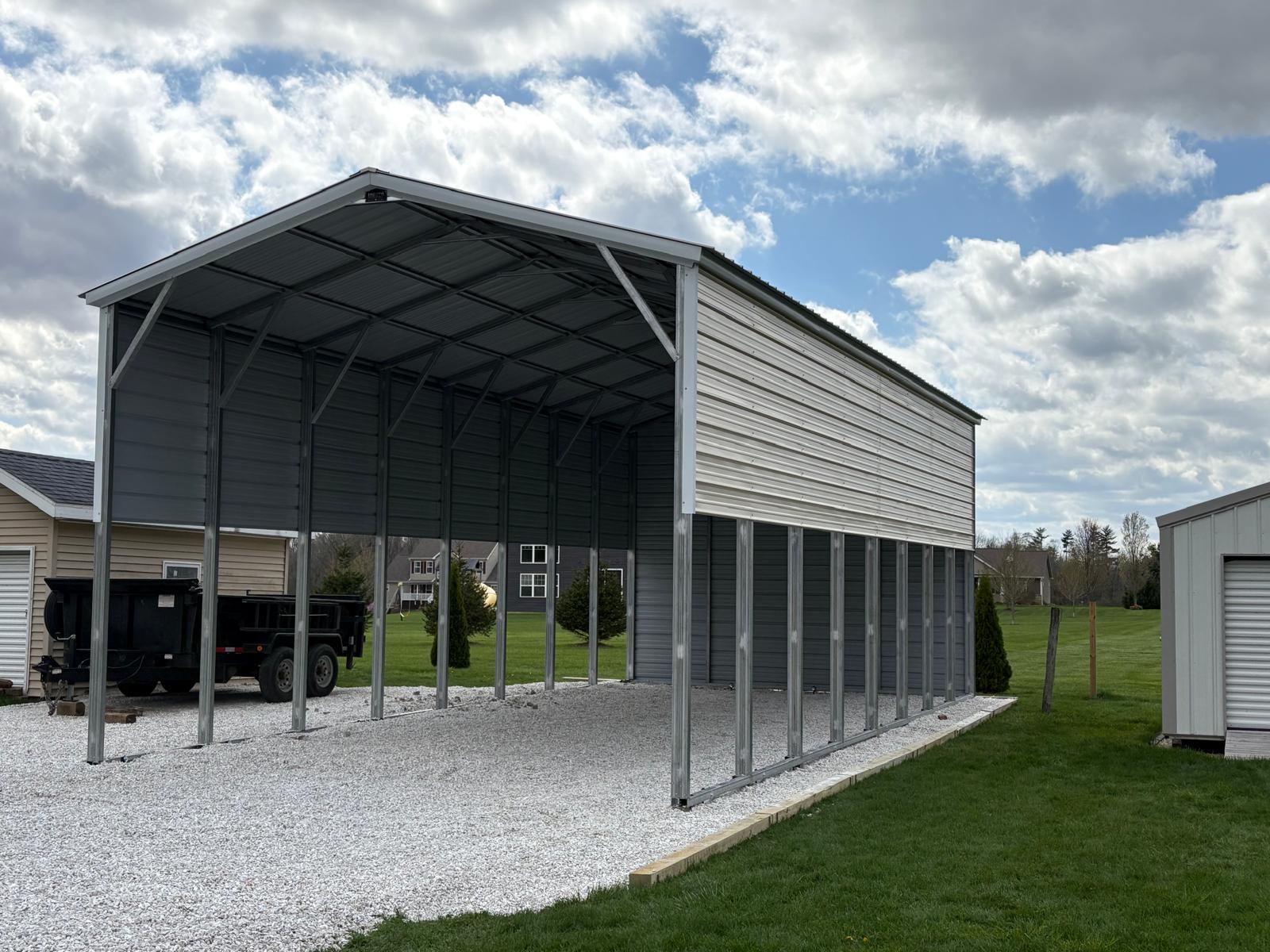
An RV port is an open-sided, roofed steel structure sized to fit your motorhome, travel trailer, or fifth wheel. Unlike a tarp cover or a portable canopy, a steel RV port is a permanent, anchored structure, engineered for your county's snow load and wind, and built to last decades. Think of it as a carport built specifically around RV dimensions: taller, longer, and often with extra clearance for roof-mounted air conditioners and awnings.
✔ Real height clearance. Most RV ports start around 12 to 16 feet tall, tall enough for Class A motorhomes, fifth wheels, and roof AC units. We size the height to your specific RV.
✔ Length that fits your rig. RV ports commonly run 40 feet or longer, with the option to cover a tow vehicle or boat alongside the RV.
✔ Protection from UV, hail, and tree sap. Constant sun exposure fades decals, dries out seals, and cracks roof membranes. A steel roof stops that damage before it starts.
✔ No more snow removal before every trip. Covered RVs don't need to be dug out or de-iced before you can hook up and go.
✔ Lower insurance and resale risk. A covered RV holds its value better and shows less weather wear at trade-in or resale time.
✔ Fast installation. Like our carports, most RV ports go up in a single day, with typical lead times of 2 to 5 weeks, weather permitting.
This is the first real decision to make, and it comes down to budget and how you use your RV.
Open RV port: The most affordable option. It protects against sun, snow, and hail while keeping your RV fully accessible for quick trips. No foundation is required, and it can be anchored to gravel, asphalt, or concrete.
Enclosed RV garage: Add one, two, or three walls, end walls, and a roll-up door sized for your RV's height, and your open port becomes a lockable, enclosed RV garage. This is a popular upgrade for owners who store valuables inside the RV over winter or want extra security.
Because every structure we build is made to order, you're never locked into one or the other. Many owners start with an open RV port and enclose it later as their needs change.
Getting the dimensions right the first time avoids a costly redo. Before you order, measure:
✔ Overall RV length, bumper to hitch, plus a few feet of clearance on each end.
✔ Overall height, including roof-mounted AC units, vents, and satellite domes; add clearance for slide-outs if you plan to open them under cover.
✔ Width, especially if you want room to walk around the RV or park a second vehicle alongside it.
✔ Ground clearance and turning room for backing the RV in and out comfortably.
Every RV port we install is engineer-certified for your county's snow load and wind, the same standard we apply to our carports, garages, and barns. For long spans, we recommend a vertical roof so snow and meltwater slide off the ends instead of pooling on top. If you store your RV through the winter, a vertical roof and enclosed sides make a real difference in how much snow, ice, and drifting you deal with come spring.
Permit requirements vary by township, just like carports and garages. Because an anchored RV port is a permanent structure, most jurisdictions require a permit above a certain footprint or height. Check with your local building department before you order; when needed, our manufacturers can provide generic engineering plans and contractor license documentation to help with your application.
How tall does an RV port need to be? Most RV ports are built 12 to 16 feet tall to clear roof AC units and antennas. We size the height around your specific RV's measurements.
Is an RV port cheaper than an RV garage? Yes. An open RV port costs less than an enclosed RV garage because it uses less material and doesn't require a roll-up door. You can always add walls and a door later to enclose it.
Can an RV port also cover a tow vehicle or boat? Yes. Many owners size their RV port a few feet wider or longer than the RV alone, so a truck, car, or boat fits under the same roof.
Will a steel RV port hold up to Wisconsin snow? Yes. Every RV port is engineer-certified for your county's snow load and wind, and a vertical roof is recommended to shed heavy snow efficiently.
Do I need a concrete pad for an RV port? No. RV ports can be anchored to gravel, asphalt, or the ground, though a concrete pad gives you the cleanest surface if you plan to use the space as a workspace too.
Get a free, no-obligation custom quote, engineer-certified and installed in 2–4 weeks.
Design It Yourself · In 3D
Watch your structure come together panel by panel. Pick the size, roof, doors, colors and add-ons, andsee your price update live, no pressure, no hidden fees.
.png)
Live, transparent pricing as you build
Every option visualized before you order
Save your design and get an exact installed quote
.png)
Featured Models
Real configurations with estimated pricing, delivery and installation included. Every build is custom-made for your project.

Installed Throughout the Midwest
Beyond the Build
Tricky site? We have you covered, literally. And every structure is backed for the long haul.
.png)
.png)
.png)

.png)
Barndominiums
Read more
.png)
No obligation, best price guaranteed across the Midwest.

.png)


